
EDUCATION / PROTOTYPE
Faro Agent.
Read the signals, explain the proposals, leave the choice to people.
I contribute to Faro Agent, a group prototype exploring university study support. Using simulated data, we explore how to make a cohort’s difficulties understandable and propose reasoned tutoring and recovery plans, with human review.
The project at a glance
- Area
- Artificial Intelligence
- Technologies
- JavaScript · HTML · CSS
- Status
- Prototype with simulated data
- Explore
- Code and documentation
- Context
- Prototype · simulated data
The group project
I participate in Faro as a group project exploring university study support. I collected the prototype and collaboration documentation in the repository. The work explores indicators, reasoned proposals and tutoring constraints using simulated data.
Where the project begins
Context before code.
An indicator about someone’s studies does not, on its own, explain which intervention would help. Before proposing support, the signals need to be understandable, the reasoning visible and the available resources considered. A dashboard that classifies without explaining may hide the very decisions it should help people discuss.
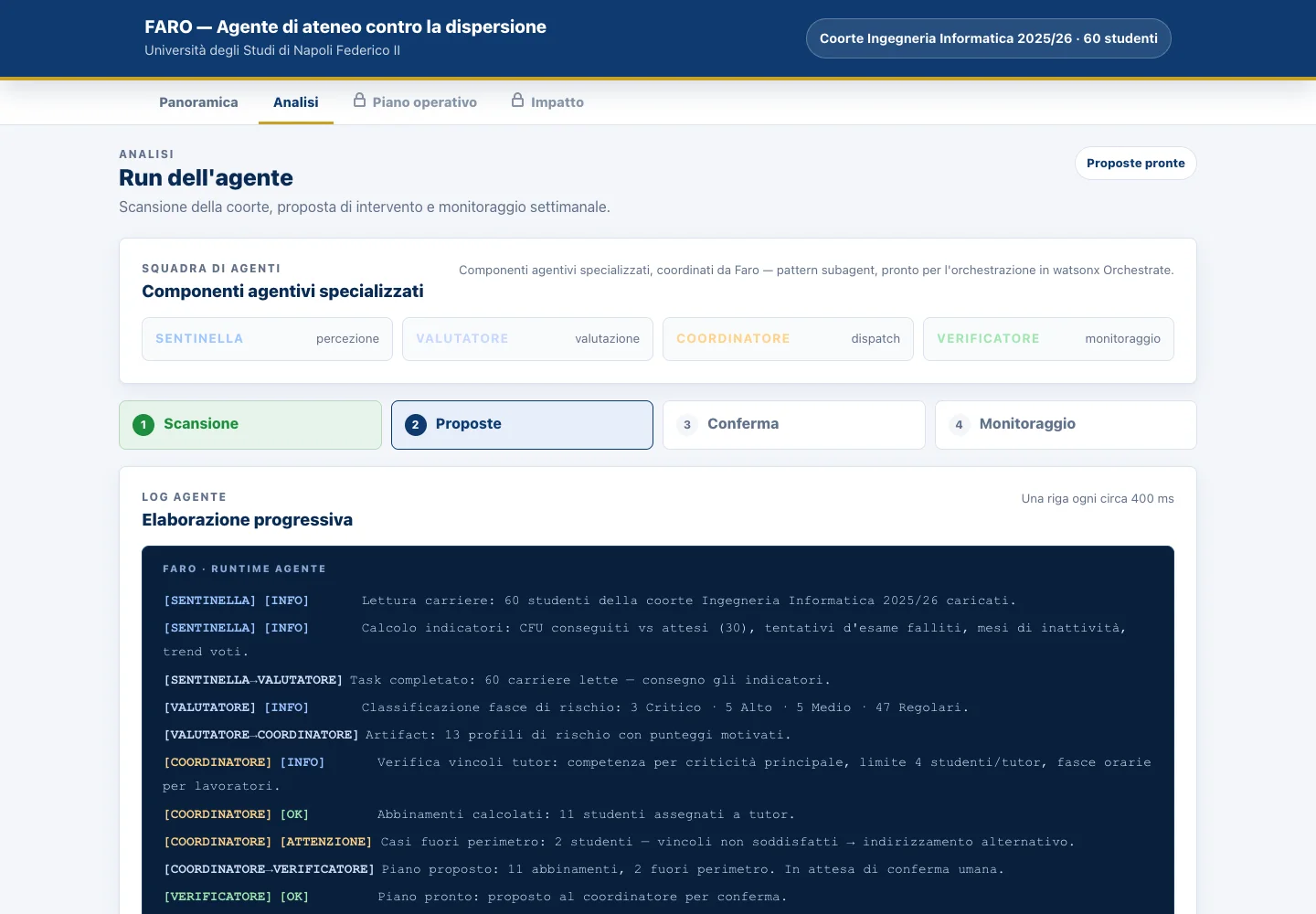
Faro explores this question in a demonstration setting with 60 fictional students and 5 fictional tutors. This simulated scope allows rules, constraints and interactions to be explored without accessing real university records. These figures describe the demo dataset, rather than students reached or outcomes achieved.
The workflow
Design choices, one step at a time.
The project’s journey, from the initial information to what people can do.
- 01 Fictional cohort
- 02 Indicators and rules
- 03 Reasoned proposals
- 04 Review and simulation
Define the simulation’s scope first.
The demo uses HTML, CSS and JavaScript and opens directly in the browser. Basic operation does not require a backend and does not query university administration systems, teaching databases or authentication services.
The prototype can be explored in the browser with a fictional cohort: every indicator belongs to the demonstration scenario.
Connect indicators to understandable reasons.
The analysis uses explicit rules and produces reasoned proposals. The aim goes beyond highlighting a situation: it makes the transition from signal to possible support open to discussion, showing what led to the proposal and what supports it.
The recovery plan is a proposal for discussion. Its reasoning makes the transition from indicators to a possible intervention visible.
Consider tutoring constraints.
The project includes constrained matching between simulated students and tutors. This shifts attention from an abstract list of needs to a proposal that must account for available support resources.
Simulating the following week shows how views change within the scenario. It tests the demo rather than measuring the effectiveness of a real intervention.
Separate rules from text generation.
Text drafts can use a configurable IBM proxy, with a local fallback. The shared version has an empty configuration; a remote service that has not been connected is not assumed to be active.
The rules engine and optional writing support have separate roles: one constructs proposals, while the other can help express them. People remain responsible for assessment.
Inside the project
Technology has a job to do.
Tools and components, explained through their role in the system.
JavaScript in the browser
Demo logic and interactions, with no dependencies to install for basic operation.
Rules and constraints
Indicators, support proposals and reasoned matches. The dataset contains only fictional students and tutors.
Separate integrations
An optional proxy for text drafts; integration with ComeSiSupera remains to be designed. No real email delivery or university records are connected.
Current state and next steps
What exists today.
The available result is a browsable prototype showing the stages of a support journey: analysis, proposal, reasoning and simulation. Group specifications and documentation accompany the code.
For me, the project’s value is making a proposal open to discussion: showing indicators, stating constraints and leaving room for conversation with the people supporting the student’s journey.
People and documentation
Contributions and sources.
A group effort. The repository preserves the prototype, specifications and collaboration documents.
Beyond the case study
Based on the public project documentation consulted on 19 October 2026. Decorative illustrations are graphic representations; real screenshots are identified in their captions.